

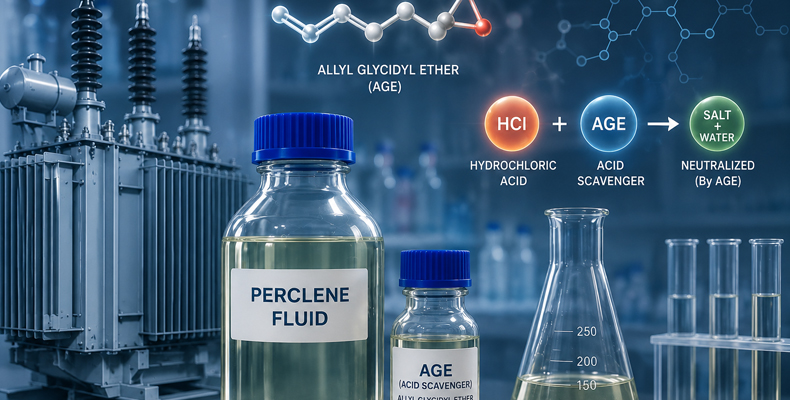
AGE Acid Scavenger (Perclene Fluid)
SDMyers, LLC. In-house test method
AGE is an abbreviation for a chemical whose full name is allyl glycidyl ether. (The abbreviation is usually pronounced by pronouncing the individual letters A-G-E, rather than like the word “age”.) AGE is a chemical that is added to some perchloroethylene-based insulating liquids. The purpose of the AGE additive is to act as an acid scavenger when these liquids were used as retrofill fluids for Askarel transformers. As perchloroethylene fluid ages, it breaks down and forms hydrochloric acid. The AGE additive acts to neutralize this acid, so that the acid does not react with the metals in the transformer.
Note that AGE additive applies to perchloroethylene-based retrofill fluids only. Manufacturers of original equipment perchloroethylene insulating liquids addressed the prospect of fluid breakdown and acid formation differently. (Wecosol by Westinghouse is the most frequently encountered original equipment perchloroethylene insulating liquid.) Therefore, the AGE test is appropriate for samples from former Askarel-filled transformers that were retrofilled with a perchloroethylene-based liquid (most frequently Perclene).
The AGE test determines the amount of the AGE additive that is in the fluid. The amount of sample needed for the test is fairly small, about 5 mL. Test results are reported in custom letter format, giving the AGE concentration in ppm (parts per million), together with recommendations.
SDMyers, LLC. guidelines regarding AGE content are as follows:
If a transformer requires AGE acid scavenger replenishment, it is important that this maintenance be done in order to prevent irreversible damage to the metals in the transformer from the build up of acids. If AGE acid scavenger is not added, acids will eventually form due to the breakdown of the fluid and attack the metals in the transformer, making the transformer unreliable.
AGE is an abbreviation for a chemical whose full name is allyl glycidyl ether. (The abbreviation is usually pronounced by pronouncing the individual letters A-G-E, rather than like the word “age”.) AGE is a chemical that is added to some perchloroethylene-based insulating liquids. The purpose of the AGE additive is to act as an acid scavenger when these liquids were used as retrofill fluids for Askarel transformers. As perchloroethylene fluid ages, it breaks down and forms hydrochloric acid. The AGE additive acts to neutralize this acid, so that the acid does not react with the metals in the transformer.
Note that AGE additive applies to perchloroethylene-based retrofill fluids only. Manufacturers of original equipment perchloroethylene insulating liquids addressed the prospect of fluid breakdown and acid formation differently. (Wecosol by Westinghouse is the most frequently encountered original equipment perchloroethylene insulating liquid.) Therefore, the AGE test is appropriate for samples from former Askarel-filled transformers that were retrofilled with a perchloroethylene-based liquid (most frequently Perclene).
The AGE test determines the amount of the AGE additive that is in the fluid. The amount of sample needed for the test is fairly small, about 5 mL. Test results are reported in custom letter format, giving the AGE concentration in ppm (parts per million), together with recommendations.
SDMyers, LLC. guidelines regarding AGE content are as follows:
- >1500 ppm AGE is Acceptable (2000 to 2500 ppm is optimum)
- >>1000 ppm, but ≤1500 ppm AGE is Questionable
- ≤1000 ppm AGE is Unacceptable
- If ≤1500 ppm, but >0 ppm, AGE content should be replenished.
- If AGE content is depleted (0 ppm), the transformer may be unreliable and should be replaced.
If a transformer requires AGE acid scavenger replenishment, it is important that this maintenance be done in order to prevent irreversible damage to the metals in the transformer from the build up of acids. If AGE acid scavenger is not added, acids will eventually form due to the breakdown of the fluid and attack the metals in the transformer, making the transformer unreliable.