

Corrosive Sulfur
Standard Test Method for Corrosive Sulfur, ASTM D1275B
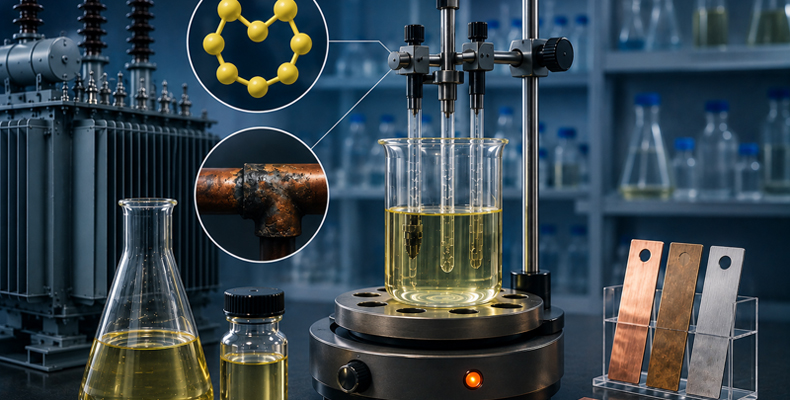
Corrosive sulfur is a chemical property of the oil, and the test for it is either pass or fail. While sulfur content relates to the composition of the oil, the presence or absence of corrosive sulfur in new oil is more appropriately considered to be a test for purity – properly refined new transformer oil should pass the corrosive sulfur test. Free, elemental sulfur and some sulfur containing compounds in new oil will react with metals in the transformer, particularly copper and silver, which leads to corrosion of conductor, connections, and soldered or braised joints. This is foremost a new oil test – virtually all specifications in use in North America require that new oil pass the corrosive sulfur test. There has been some use of the test for in-service oils. Where corrosion of conductor or unusual deposits of hard, black material have been noted, the test is run to determine whether corrosive sulfur from the oil is responsible. There have been some suggestions that new oil which passes a corrosive sulfur test may develop a corrosive sulfur content while in-service as certain compounds in the oil which contain tightly bound sulfur (these do not react in the corrosive sulfur test) may change chemically under thermal or electrical stress, allowing reformed corrosive sulfur compounds to react with metals.
Corrosive sulfur is a chemical property of the oil, and the test for it is either pass or fail. While sulfur content relates to the composition of the oil, the presence or absence of corrosive sulfur in new oil is more appropriately considered to be a test for purity – properly refined new transformer oil should pass the corrosive sulfur test. Free, elemental sulfur and some sulfur containing compounds in new oil will react with metals in the transformer, particularly copper and silver, which leads to corrosion of conductor, connections, and soldered or braised joints. This is foremost a new oil test – virtually all specifications in use in North America require that new oil pass the corrosive sulfur test. There has been some use of the test for in-service oils. Where corrosion of conductor or unusual deposits of hard, black material have been noted, the test is run to determine whether corrosive sulfur from the oil is responsible. There have been some suggestions that new oil which passes a corrosive sulfur test may develop a corrosive sulfur content while in-service as certain compounds in the oil which contain tightly bound sulfur (these do not react in the corrosive sulfur test) may change chemically under thermal or electrical stress, allowing reformed corrosive sulfur compounds to react with metals.