

Dissolved Metals (ICP)
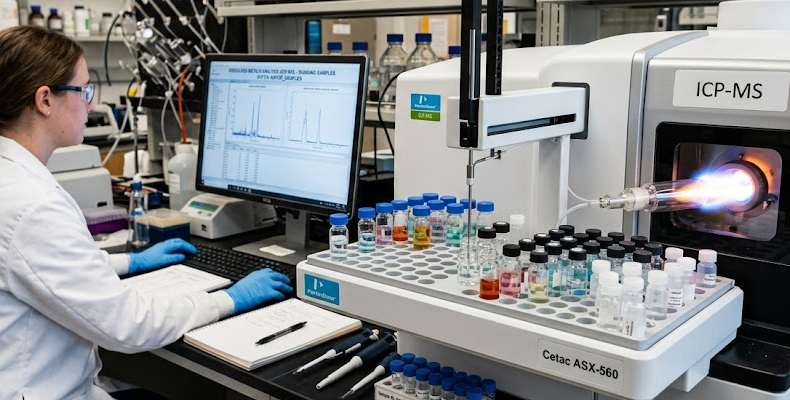
Dissolved Metals by ICP, Standard Test Method for Determination of Elements in Insulating Oils by Inductively Coupled Plasma Atomic Emission Spectroscopy (ICP-AES, ASTM D7151)
Dissolved copper and other metals act as catalysts to promote oxidation and also serve to elevate liquid power factor to unacceptable levels. Dissolved metals in sufficient quantity to promote aging of the oil can be removed by reclamation. Dissolved metals analysis is also useful to help diagnose fault conditions such as severe overheating or arcing/sparking indicated by other tests such as dissolved gas analysis. Dissolved metals analysis is sometimes performed on new oil to evaluate whether refining or storage practices are resulting in elevated dissolved metals levels being introduced into the system. Since dissolved metals levels are generally measurable with brand new transformers, once energized, and tend to go decrease to “none detected” levels before gradually increasing due to aging or jumping due to fault conditions, the recommendation for in-service oil is to baseline test units and then test every few years to evaluate gradual increases in metals. If dissolved metals content is to be used to help identify a transformer fault, the abnormal dissolved gas analysis will trigger a recommendation to perform metals analysis. Standard procedure is to test samples routinely for copper, iron, and aluminum, although many others can be run if conditions indicate a need.
Dissolved copper and other metals act as catalysts to promote oxidation and also serve to elevate liquid power factor to unacceptable levels. Dissolved metals in sufficient quantity to promote aging of the oil can be removed by reclamation. Dissolved metals analysis is also useful to help diagnose fault conditions such as severe overheating or arcing/sparking indicated by other tests such as dissolved gas analysis. Dissolved metals analysis is sometimes performed on new oil to evaluate whether refining or storage practices are resulting in elevated dissolved metals levels being introduced into the system. Since dissolved metals levels are generally measurable with brand new transformers, once energized, and tend to go decrease to “none detected” levels before gradually increasing due to aging or jumping due to fault conditions, the recommendation for in-service oil is to baseline test units and then test every few years to evaluate gradual increases in metals. If dissolved metals content is to be used to help identify a transformer fault, the abnormal dissolved gas analysis will trigger a recommendation to perform metals analysis. Standard procedure is to test samples routinely for copper, iron, and aluminum, although many others can be run if conditions indicate a need.